
Connecting Frontstage & Backstage with Agentforce 360 for Manufacturing Client
A research-led transformation initiative using service blueprinting to diagnose misalignment and prepare Siemens for AI-driven change.
Timeline
4-month research
Deliverables
Current-State Service Blueprint (Frontstage & Backstage)
Persona Set – Frontstage & Backstage
Service Blueprint Future State
Story Arc for Future State
KPIs (Current State vs. Target) & Benchmark Analysis
Opportunities with the Agentic Enterprise (Future State)
Introduction
By 2019, Siemens’ industrial B2B commerce ecosystem had grown into a complex network of digital touchpoints, product platforms, partner portals, MindSphere applications, and global sales and service operations. Each part delivered value on its own—but the whole system wasn’t working together.
Industrial buyers struggled to find consistent product information.
Marketplace users experienced friction navigating apps and services.
Business partners lacked visibility into order status and configuration data.
Internally, sales, service, product teams, and marketing each worked in their own systems with limited alignment.
The ambition was clear:
Create one connected Siemens experience — for customers, partners, and employees.
And build the future on Salesforce Einstein 1 Commerce and Agentforce 360.
But before Siemens could transform its future, it first needed to understand its present. And that required a new approach.
Goal
The goal of this case study is to demonstrate how a cross-functional, research-driven service blueprinting approach uncovered the root causes of Siemens’ fragmented B2B Marketplace experience and enabled the organization to align on a shared understanding, co-create a future-state vision, and define a clear 18-month roadmap for transforming the customer and internal operational experience.
Research
Why Customer Personas Were Not Enough
Before planning the workshop, I conducted a research phase drawing from Siemens’ past studies, analytics, and stakeholder interviews. My initial hypothesis was that customer personas (industrial buyers and users) would highlight the core friction.
But something critical was missing.
Customer personas explained what was happening.
They did not explain why it was happening.
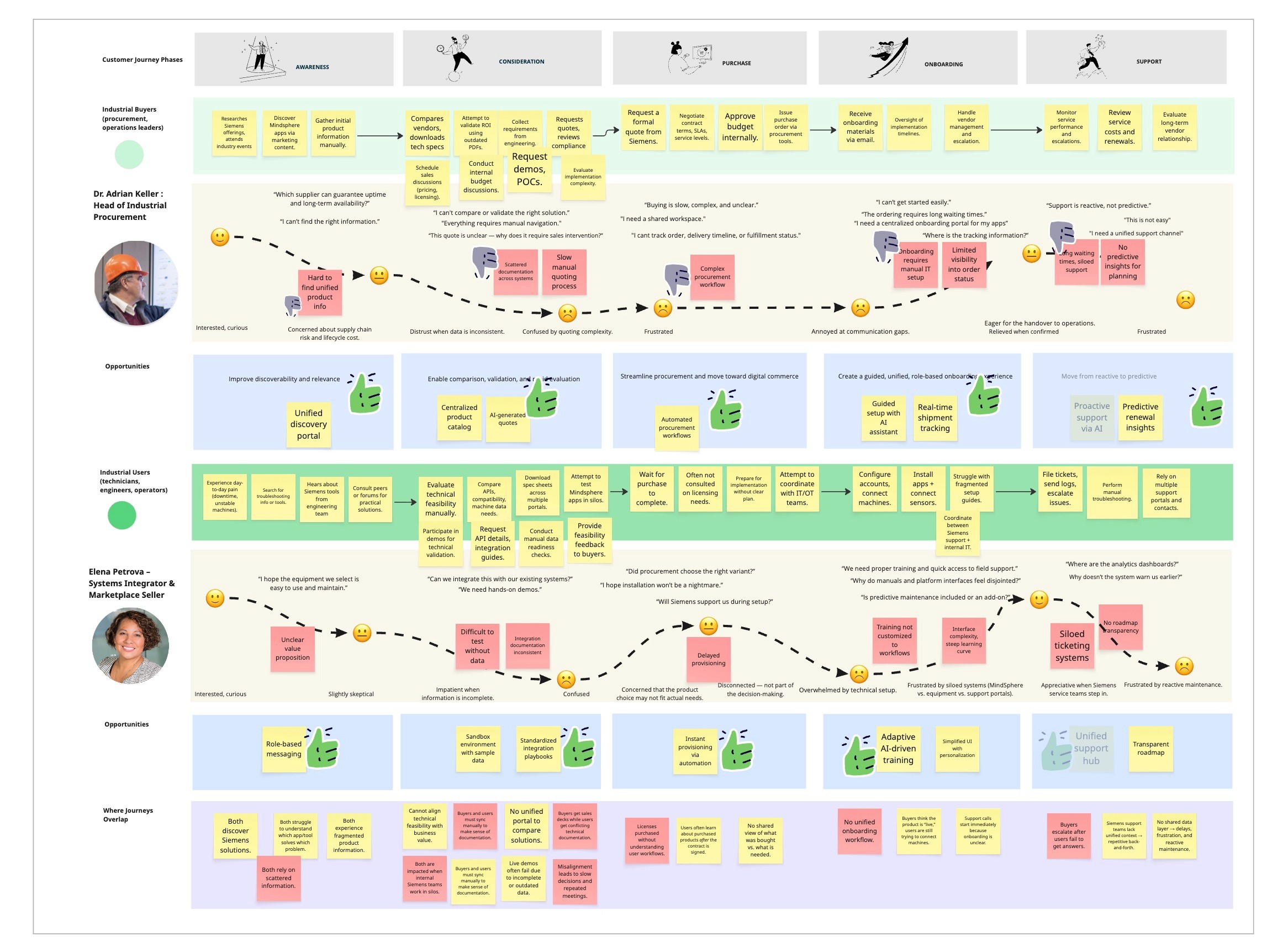
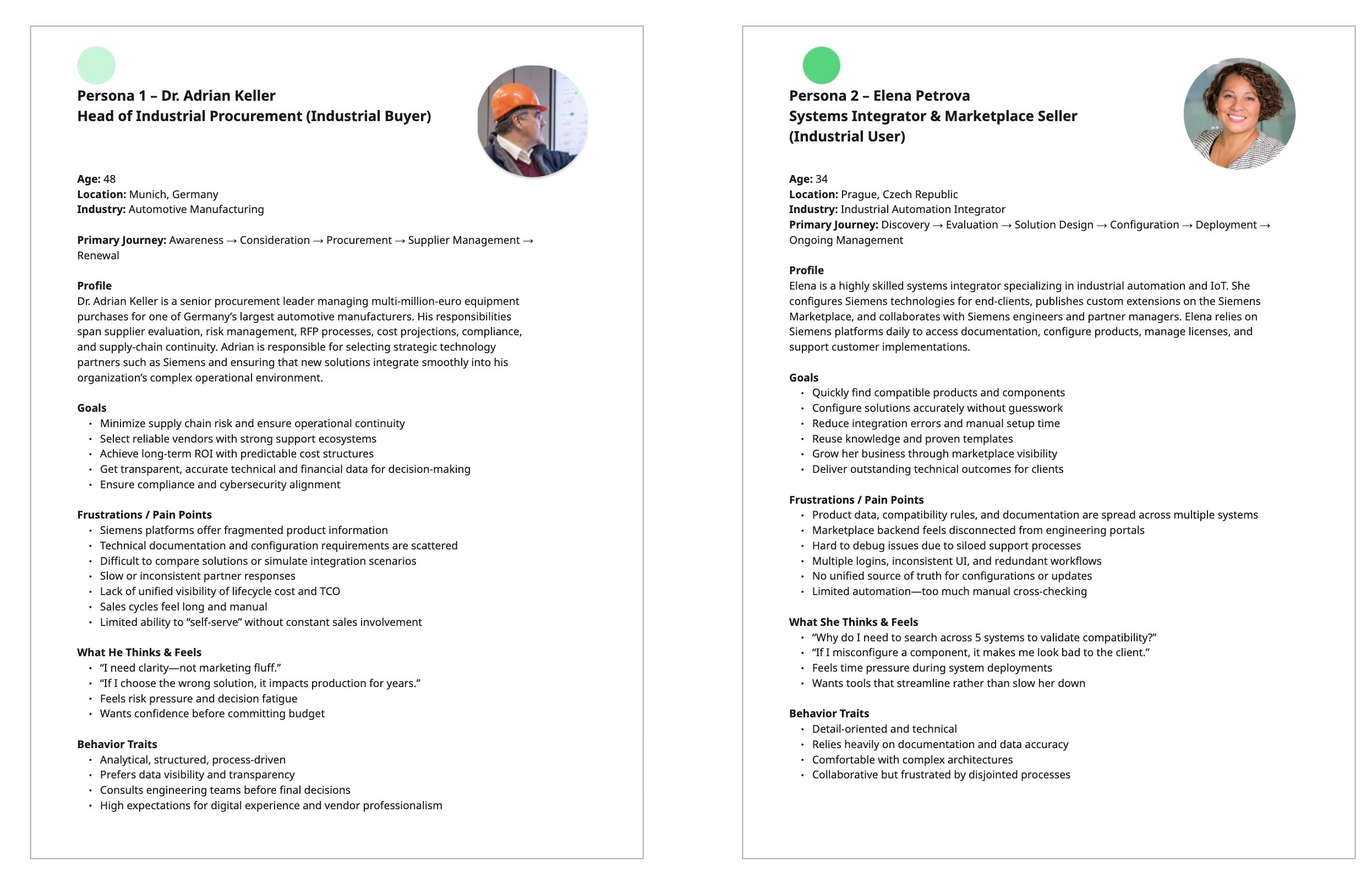
Frontstage Personas
These personas represented the external experience.
Persona | Role |
|---|---|
Dr. Adrian Keller | Industrial Buyer / Procurement Lead |
Elena Petrova | Marketplace User (Integrator / OEM App User) |
Marco Hernández | Business Partner (VAR / OEM Ecosystem Partner) |
Interviews
Interviews quickly revealed that the real breakdowns were internal:
Sales had no visibility into service history or product usage.
Service teams couldn’t access configuration or part data.
Product teams iterated on MindSphere apps without customer context.
Marketing operated automated journeys based on incomplete data.
Partner managers used tools not connected to Siemens’ CRMs.
The problem wasn’t only in the frontstage.
It was systemic.
This discovery prompted me to expand the persona set to include backstage roles, capturing the full operational environment.
Backstage Personas
These personas represented internal operations powering the experience.
Persona | Role |
|---|---|
Sophie Meier | Siemens Sales Representative |
Marcus | Product Owner, MindSphere App Team |
Rajiv Menon | Service & Field Support Lead |
Laura Schmidt | Partner Manager |
Miguel Santos | Data Analyst |
Hannah Weber | Marketing Lead |
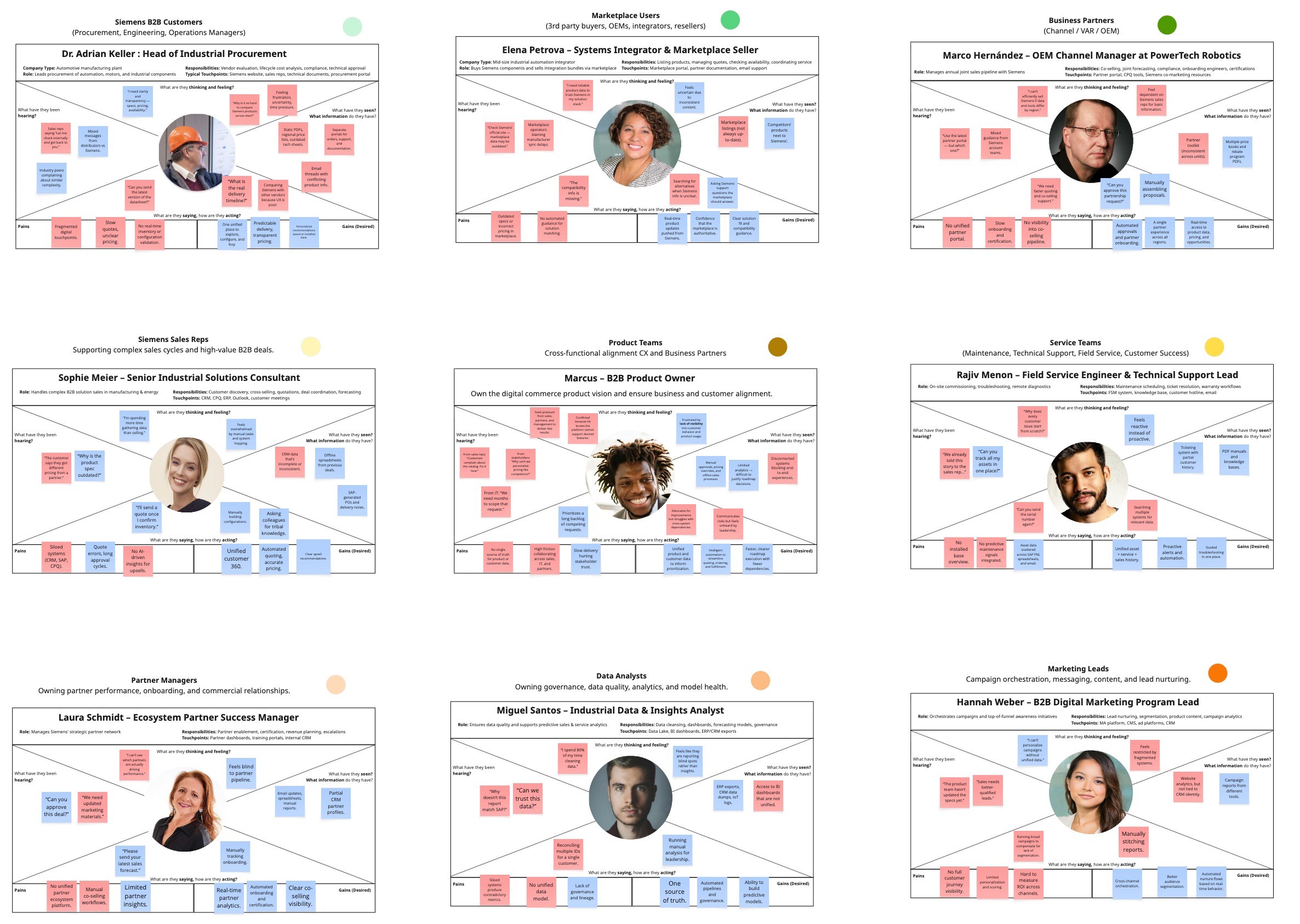
Together, these personas provided a complete lens for understanding misalignment across workflows, systems, and data touchpoints.
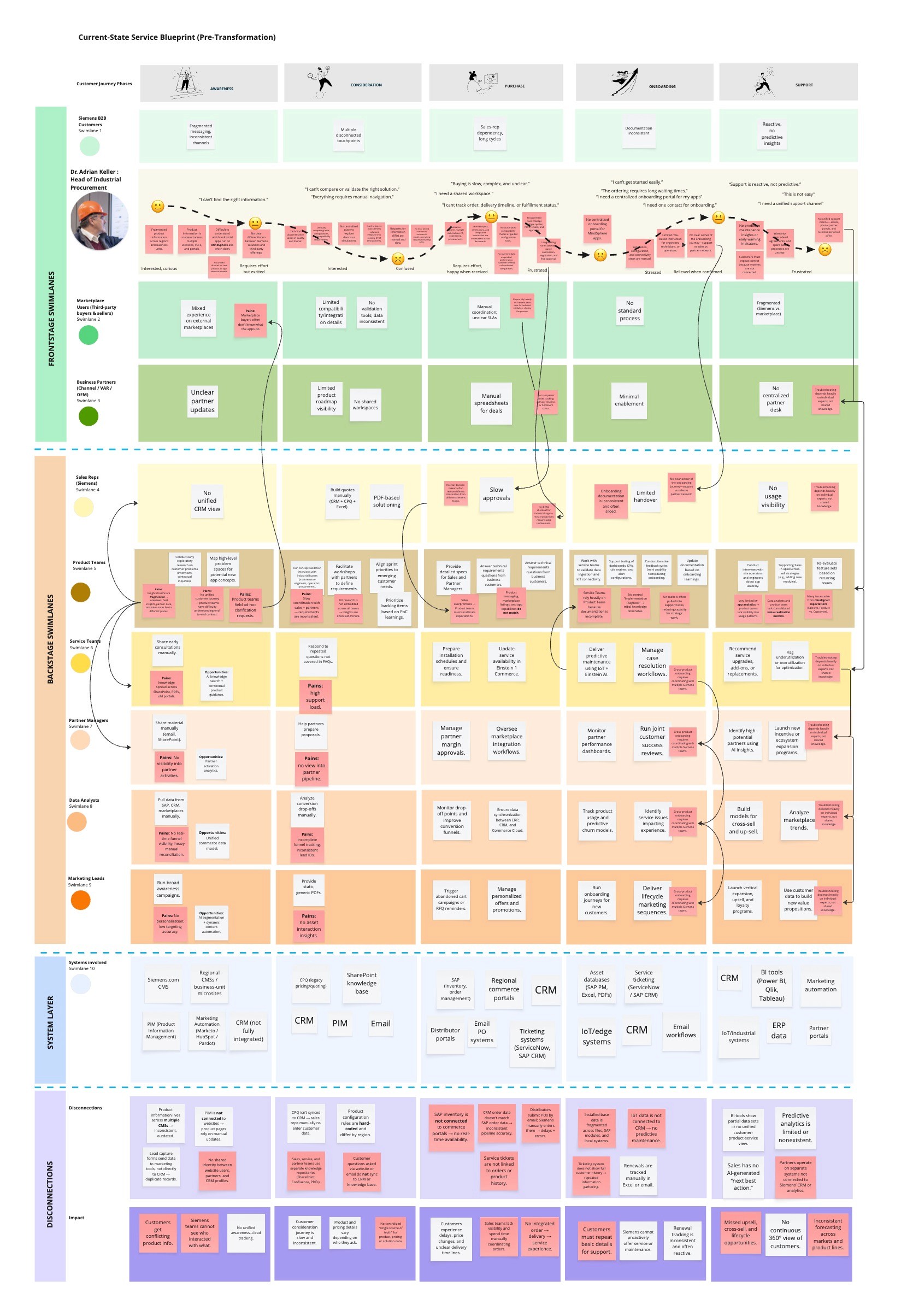
The Current-State Service Blueprint
Exposing the Hidden System
Mapping the entire Siemens industrial commerce ecosystem from awareness → consideration → purchase → onboarding → retention revealed the core gaps:
Horizontal Misalignment (Across Customer Journey)
Every channel (portal, marketplace, sales, MindSphere apps) delivered a different experience.
Product information lived in multiple formats with no single source of truth.
Buyers jumped between systems to complete basic tasks.
Vertical Misalignment (Frontstage ↔ Backstage)
Customers experienced friction because internal teams were not aligned:
Sales, service, partner management, product teams, and marketing worked in isolated tools.
No shared customer record.
No shared workflow or escalation structure.
No unified product or content architecture.
The blueprint helped all workshop participants see:
Siemens offered multiple entry points—but not all of them were connected.
This insight became the foundation for transformation.
Breaking down all Stages of the Current Service Blueprint
Frontstage Swimmlanes
Backstage Swimmlanes
System Layer
Disconnections
The Workshop
To create alignment across ten roles, I designed a full-day Design Thinking workshop that combined storytelling, service blueprinting, capability mapping, and AI readiness assessment.
Activities
Reality Check-In
Co-creating the Problem Statement
Capability Mapping
Dependency Identification
Participants
One representative from each service blueprint swimlane
Outcome
A shared, cross-functional understanding of the problem and capabilities
The theme was intentional:
“We Tell Our Story”
Because transformation begins when every stakeholder understands where they fit in the system—and what story they want to create together.
Problem Statement Co-Creation
“How might we unify Siemens’ B2B commerce ecosystem so customer, partner, and employee experiences operate on one connected system?”
This became the anchor for capability mapping.
As part of the workshop activity, participants received a deck of Siemens Industrial B2B capability cards, enhanced with Salesforce Einstein 1 Commerce + Agentforce 360 capabilities, and collaboratively sorted them.
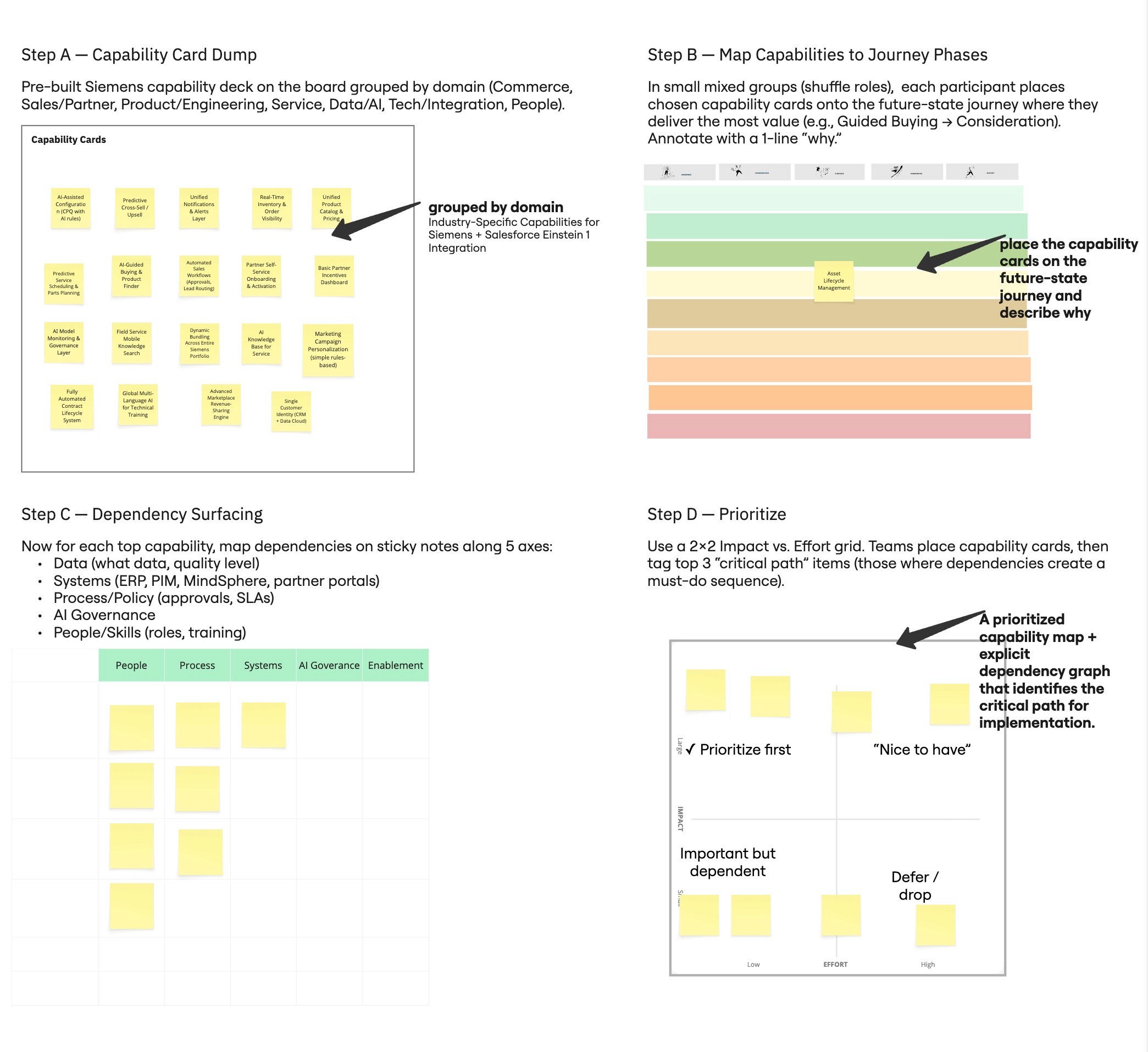
Outcome:
A prioritized capability map + a dependency system revealing the critical path for transformation. This is where the future-state “Agentic Enterprise” began taking shape.
Future-State AI-Enabled Narrative along the Story Arc
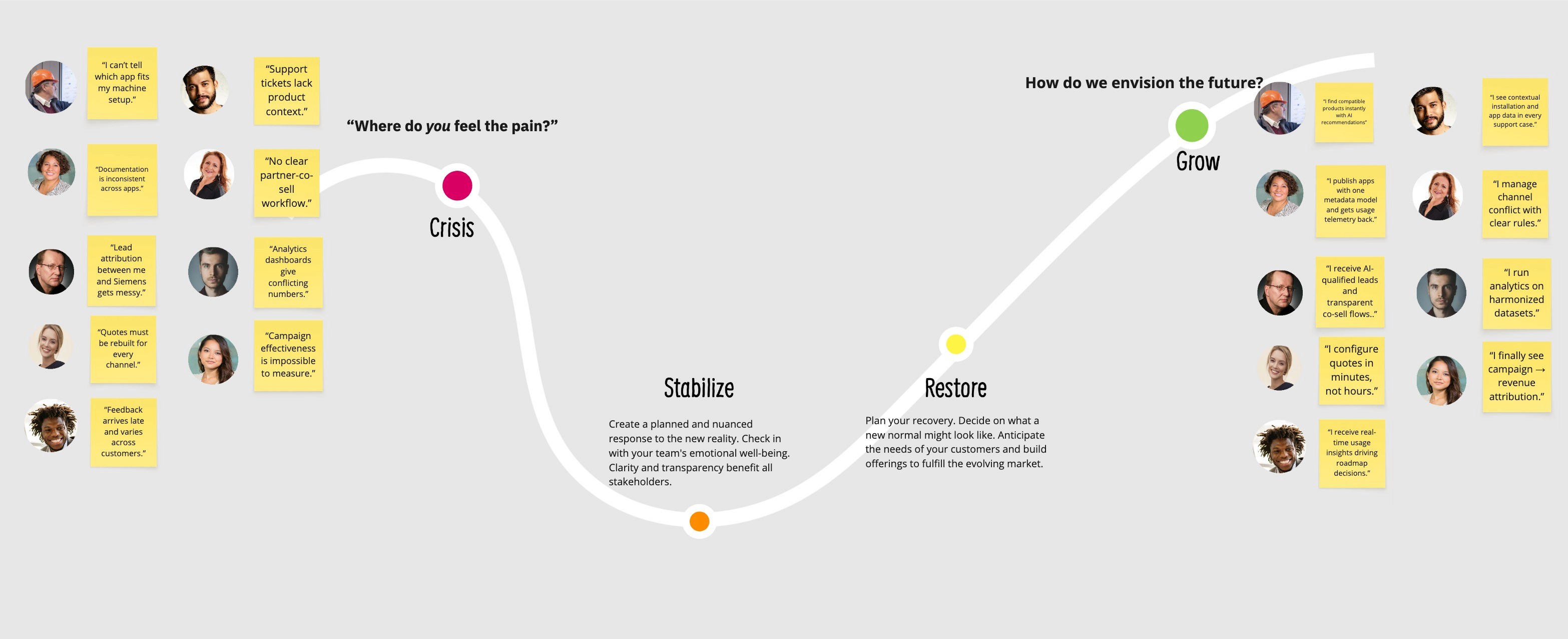
Outcome:
Everyone realized their pains were interconnected—each camper trapped in their own tent on the same mountain.
A story arc emerged:
From silos → to systems → to an intelligent, connected enterprise.
Workshop Outcomes
The workshop produced three tangible outcomes:
1. A validated Current-State Service Blueprint
The group confirmed and enriched the blueprint created during research. Stakeholders aligned on the exact points where the experience breaks—across the customer journey, internal processes, technology dependencies, and data gaps.
2. A Future-State Experience Vision
Cross-functional groups co-created a future experience that
modernizes the B2B marketplace experience,
integrates automation and recommendation systems,
connects product development cycles with real customer insights,
and clarifies operational ownership across teams.
Marcus (Product), Sophie (Sales), and Rajiv (Service) collaborated closely in defining new backstage workflows, while Dr. Keller, Elena Petrova, and Marco Hernández helped articulate the desired frontstage experience.
3. A Unified 18-Month Transformation Roadmap
The roadmap served as the bridge between insights and action. It established what Siemens needs to do—not just in product development, but across the entire service organization.
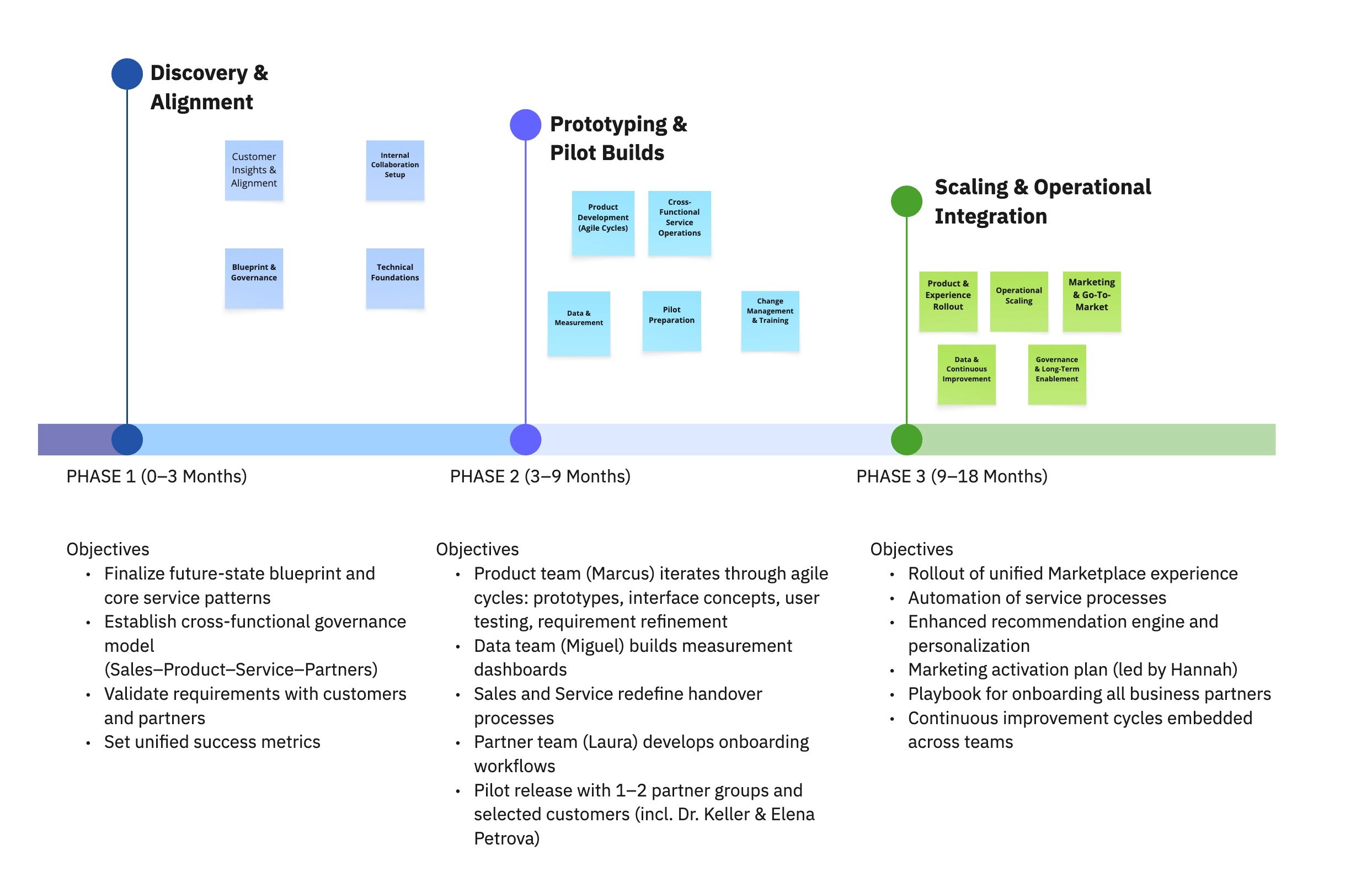
18-Month Roadmap
Key Outcomes of the Future State Blueprint
The Future State Blueprint outlines the redesigned end-to-end experience and identifies the most impactful opportunities for improvement. Key outcomes include:
Clear vision of the desired customer journey, aligned with strategic business goals and team capabilities
Identified experience gaps and friction points that can now be addressed through focused initiatives
Improved cross-team alignment, creating a shared understanding of how people, processes, and technology must interact
Defined service improvements that enable more consistent, efficient, and user-centric interactions
Prioritized opportunities for delivering value through agile iterations, validated concepts, and prototype testing
Direct linkage to the Strategic Transformation Blueprint, highlighting measurable areas for benchmark improvement and their associated KPIs
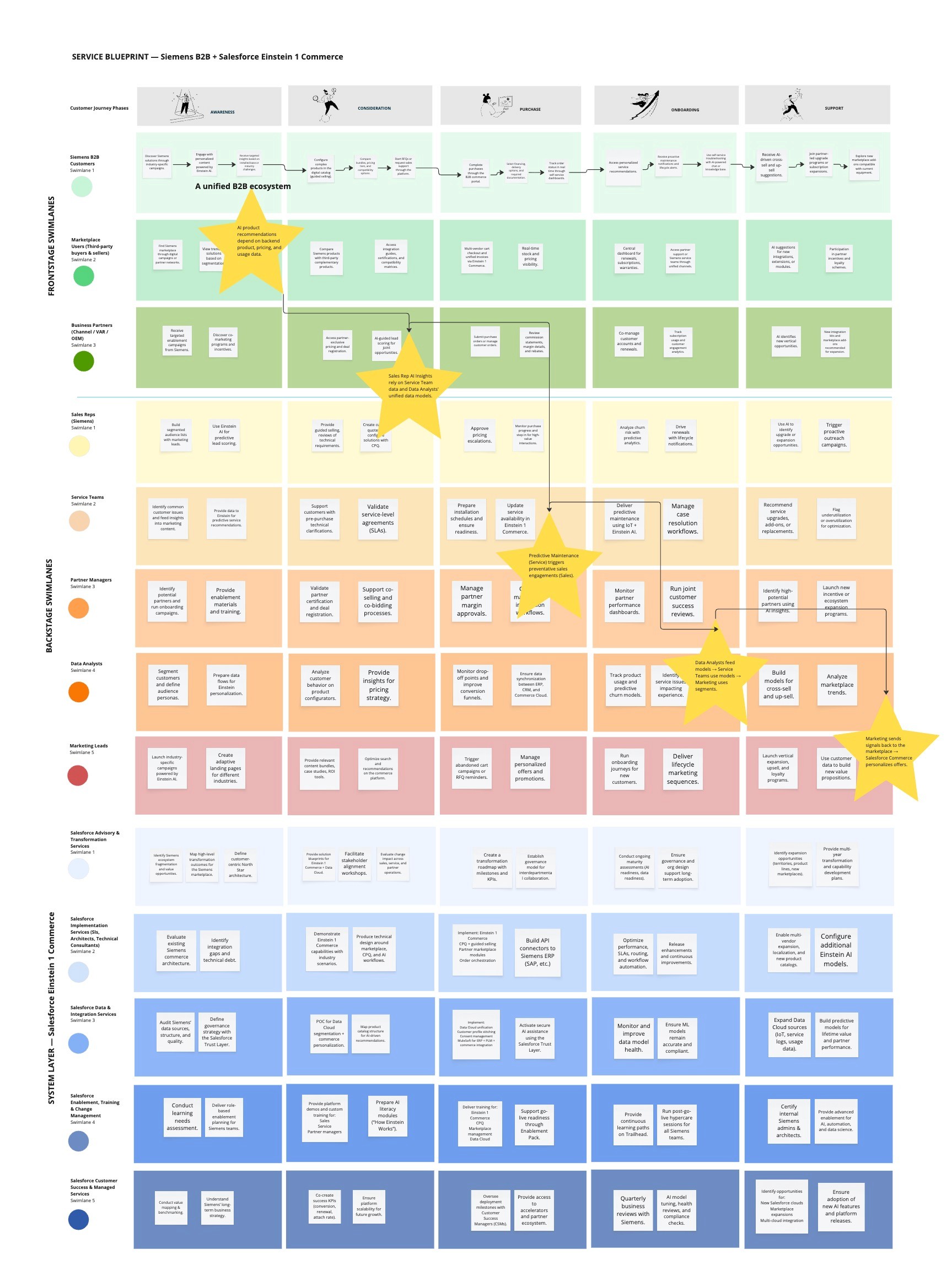
With the future-state blueprint powered by Salesforce Einstein 1 Commerce + Agentforce 360, Siemens identified clear opportunities to unify experiences, streamline operations, and introduce intelligent automation across the industrial buying journey.
Key Opportunity Themes
Experience: unify product discovery, documentation, and post-sales support.
Operations: align sales, service, product, and partner teams around shared workflows.
Technology: consolidate systems, improve data quality, and activate AI for proactive decisions.
Benchmark KPI Improvements
Faster product discovery and reduced customer friction
Shorter internal handoffs and fewer manual processes
Higher data accuracy and automation coverage
Increased NPS and partner satisfaction
Strategic Blueprint Transformation
To bridge the gap between today’s fragmented Siemens B2B commerce experience and the vision of an Agentic Enterprise, the key business stakeholders evaluated the current State and the future State, to define Opportunities with the Agentic Enterprise.
This connects to the KPI Overview, where measurable shifts in customer experience, operational efficiency, and team alignment demonstrate the impact of the redesigned service journey.
Overall Benchmark Improvement – KPI Overview
This bridges the current state (pre-Agentforce 360) and the future state (Agentic Enterprise) for Siemens’ customer experience and employee enablement journey.
KPI Category | Before: Current State | After: Future State (Powered by Agentforce 360) | Improvement | Explanation |
|---|---|---|---|---|
Customer Service Time | ⏱ 60 hours average (≈2.5 days to resolve an issue) | ⏱ 36 hours average | 🔻 −40% faster | Agentforce automates case routing, predictive maintenance, and contextual triage through AI agents. |
Customer Satisfaction (CSAT) | 😊 80% average rating | 😊 88% average rating | ⬆️ +10% increase | Context-aware recommendations, unified omnichannel experience, and proactive service communication. |
Employee Enablement Index | 👥 62% enablement | 👥 70% enablement | ⬆️ +12% increase | Employees use an integrated Agentforce workspace with guided AI workflows and Slack-based collaboration. |
Cross-Sell / Upsell Conversion | 💰 20% conversion rate | 💰 25% conversion rate | ⬆️ +25% increase | AI-driven insights identify opportunities for relevant offers during service interactions. |
Expected Impact
Dimension | Impact | Example |
|---|---|---|
CX Transformation | Seamless B2B journey across sales, service, and commerce | Customers co-design solutions via AI marketplace |
Operational Efficiency | 30% faster response to maintenance alerts | Predictive workflows automate ticketing |
Employee Empowerment | Data-driven decision confidence | Unified dashboards and Trailhead microlearning |
AI Governance & Trust | Compliance-by-design | Salesforce Trust Layer with contextual AI controls |
Recommendations & Next Steps
Execute the 18-Month Roadmap
Train & Enable All Roles
Improve Cross-Functional Collaboration
Deploy Agentforce 360 for Automation
Unify Customer & Partner Experience
Next Step: Pilot Implementation
Deploying the mission-critical use case of predictive maintenance.
Want to read more?