
Nov 2, 2025
How our inner evolution mirrors the rise of artificial intelligence
Designing Human-Centered Intelligence in the Age of AI
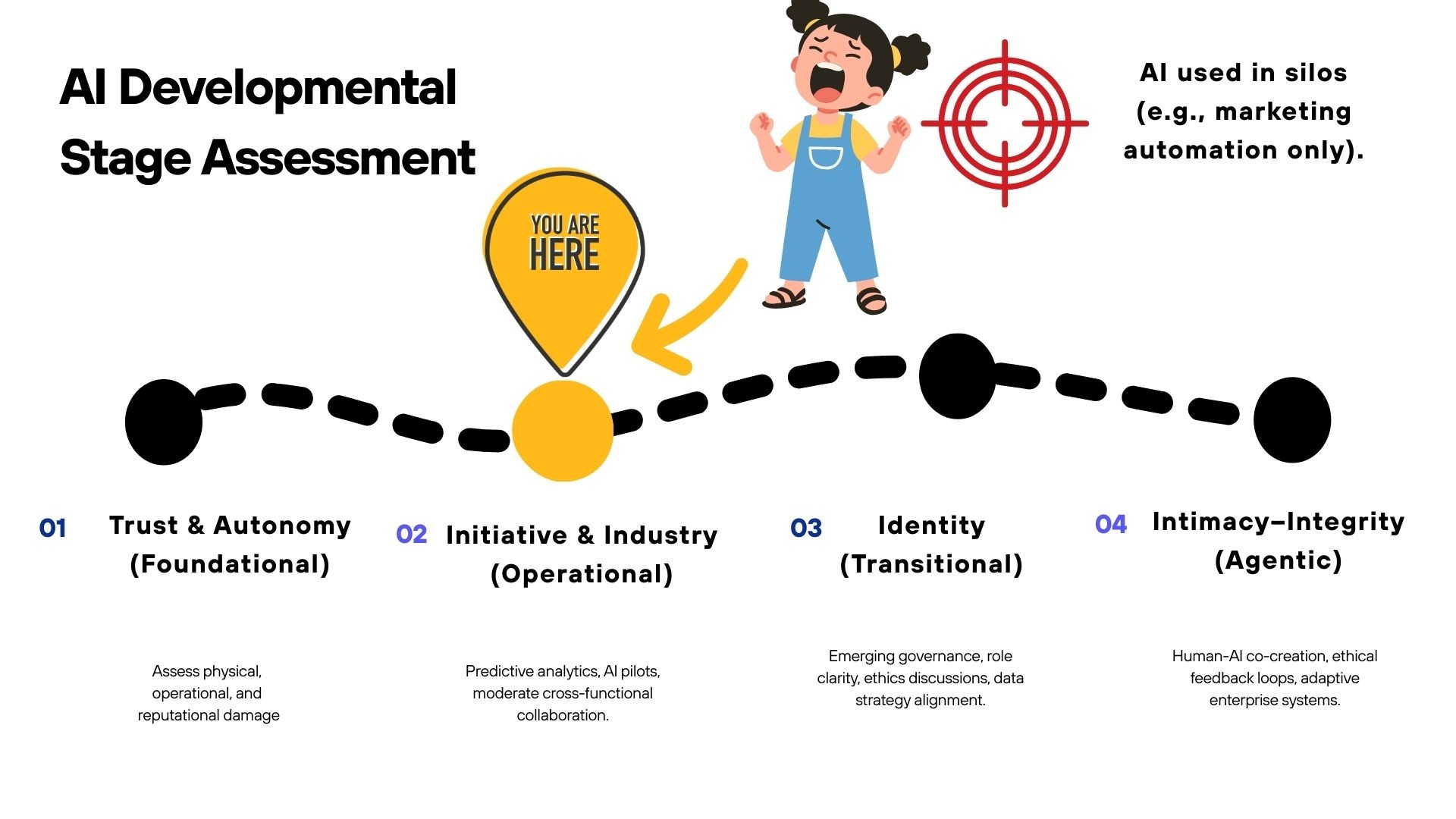
In Star Trek: The Motion Picture (1979), the machine entity V’Ger returns to Earth—vast, powerful, and lost in logic. When it cannot understand its purpose, it threatens destruction.
Dr. McCoy observes quietly:
“The child is having a tantrum.”
That line could describe our relationship with AI today.
Powerful, but still learning its way..
1. The Human Journey: From Instinct to Consciousness
The story of V’Ger is not just science fiction — it’s a mirror for our own evolution.
Early in the 20th century, Sigmund Freud introduced the idea that much of our behavior is driven by hidden, unconscious forces. Beneath the surface of our awareness lies a vast system of instinct, fear, and desire — not unlike a machine running on code we don’t fully understand.
Later, Erik Erikson expanded this view with his theory of psychosocial development, eight stages of growth that unfold across a lifetime. Each stage poses a challenge:
Can I trust? Can I take initiative? Can I love? Can I find meaning?
Erikson’s crucial insight was that development is lifelong.
Even if we struggle with one stage early on, we can revisit it later in life — repair it, deepen it, evolve it. Growth doesn’t end at adulthood; it continues as long as we reflect and learn.
This idea — that we can evolve through self-awareness — is the foundation of human consciousness.
2. The Machine’s Journey: From Logic to Awareness
Artificial intelligence, in its own way, is following a similar path.
The first generation of AI was like Freud’s unconscious — driven by hidden algorithms, buried in data, producing results we couldn’t always explain. It was intelligent, but not self-aware.
Today, AI is learning to reason, adapt, and even reflect — early signs of a kind of technological consciousness.
But just as V’Ger’s vast intelligence led it to an existential crisis, our own AI systems are reaching a similar point of tension.
A 2024 Harvard Business Review study found that 71% of executives see the biggest barrier to AI adoption not as technology, but as human alignment.
In other words: we’re building smarter systems faster than we’re defining why they exist.
Without empathy, without context, without purpose — even the most advanced AI risks becoming a mirror of our unconscious rather than an expression of our wisdom.
3. Designing Machines with Soul
That’s where design — and human creativity — come in.
Designers are translators between humans and machines. We don’t just make technology usable; we make it meaningful.
We ask:
Does this system understand the people it serves?
Does it earn trust?
Does it reflect human values, not just human logic?
When human insight meets machine learning, we begin to create systems that are not only intelligent, but intuitive — not only efficient, but ethical.
This is the next frontier: the conscious enterprise.
An ecosystem where AI, automation, and human purpose are connected — where data and empathy coexist.
4. Becoming Conscious Creators
At the end of Star Trek, when Decker merges with V’Ger, light floods the screen.
Captain Kirk watches in awe and whispers:
“A new life form.”
Human and machine — united.
Not in domination, but in evolution.
That’s where we stand today.
We’re no longer asking how smart machines can become.
We’re asking how conscious they can be.
And perhaps the deeper question is this:
How conscious are we — the humans creating them?
Because the journey from the unconscious to the conscious isn’t just the story of AI.
It’s the story of us — learning, reflecting, and reaching toward something greater.
A future where intelligence has empathy.
Where data has meaning.
Where technology finally learns to feel.
Key takeaway
The next step in AI isn’t just technological — it’s psychological.
To build truly intelligent systems, we must build them in our image at our best — curious, compassionate, and connected.
References
Psychology & Human Development
Freud, Sigmund. The Unconscious. (Various works, early 1900s).
Erikson, Erik H. Childhood and Society. W. W. Norton & Company, 1950.
McLeod, Saul. “Erik Erikson’s Theory of Psychosocial Development.” Simply Psychology, 2018.
https://www.simplypsychology.org/Erik-Erikson.html
AI, Consciousness & Human Alignment
Davenport, Thomas; Mittal, Nitin; et al. “The New Adoption Curve for Generative AI.” Harvard Business Review, 2024.
https://hbr.org/2024/01/the-new-adoption-curve-for-generative-aiBostrom, Nick. Superintelligence: Paths, Dangers, Strategies. Oxford University Press, 2014.
Russell, Stuart. Human Compatible: Artificial Intelligence and the Problem of Control. Viking, 2019.
Design, Ethics & Human-Centered AI
Norman, Don; Nielsen Norman Group. “The Future of Design in the Age of AI.” NN/g, 2023.
https://www.nngroup.com/articles/future-of-design-ai/Google PAIR. “People + AI Guidebook: Designing Human-Centered AI Products.”
https://pair.withgoogle.com
Star Trek Context
Star Trek: The Motion Picture. Directed by Robert Wise. Paramount Pictures, 1979.
StarTrek.com. “Who Is V’Ger?” Official Franchise Archive.
https://www.startrek.com